


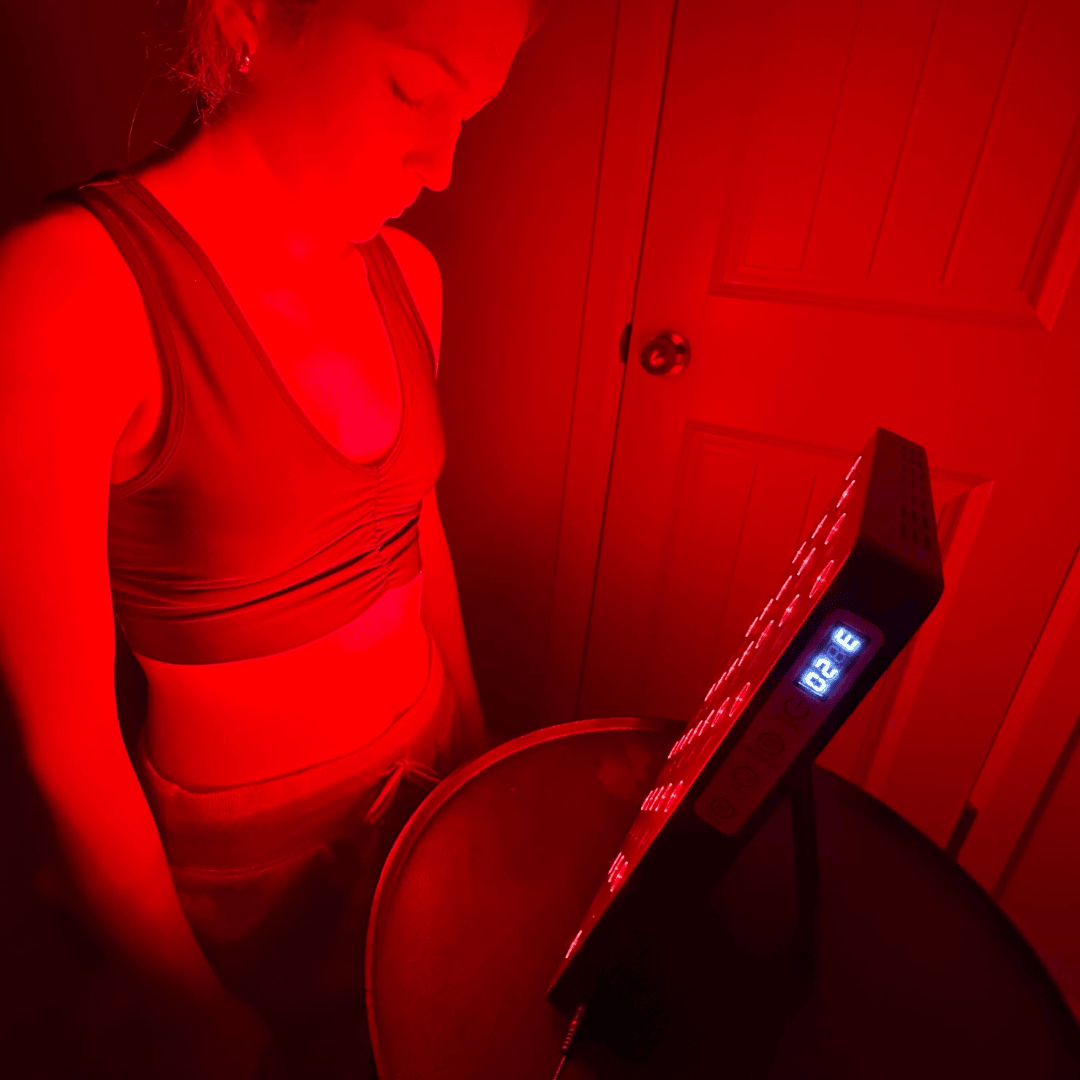
Red Light Therapy, also known as photobiomodulation (PBM), may be used to support the health of cells and tissues throughout the body. Defined as the use of red and/or near infrared (NIR) light to influence biology, most modern PBM devices emit both types of light, which have similar effects but penetrate the body to different depths. Red light is visible to the human eye, while infrared light is not, although it can be felt as heat. While early research on PBM used primarily lasers, more recent research has found that LED’s can also be used, which also have the advantage of applying light to a larger area of the body as well as an improved safety profile. The use of LED in red/NIR devices has also greatly reduced the cost of treatment, making it something that can be done in the comfort of one’s own home.
There are many mechanisms by which PBM affects the body, with the most well-known being increasing the synthesis of ATP (the energy currency of the cell) through effects on the electron transport chain in the mitochondria. The link between PBM and improved mitochondrial function has been well established. This increased supply of energy can be used to do all kinds of cellular work, including healing, growth, maintenance, and repair. There are thousands of published studies showing the efficacy of PBM for a wide range of health applications, ranging from general support for healthy cells to improving brain function in Alzheimer’s Disease patients.
Here, we will review the top 10 evidence-based uses for PBM, as supported by scientific research:
- Reduce inflammation: Red and NIR light have anti-inflammatory effects, and unlike anti-inflammatory medications (such as NSAID’s), do not cause side effects. Studies have found that PBM affects levels of many molecules involved in inflammation, including reactive oxygen species, reactive nitrogen species, and prostaglandins. The ability of PBM to reduce inflammation suggests that it could have therapeutic potential in many chronic diseases that involve inflammation, including arthritis, Alzheimer’s Disease, and depression.
- Improve skin health: Red/NIR lights are being widely used in spas and dermatology clinics for their effects on skin health, in addition to at-home use. As already mentioned, PBM can improve the appearance and healing of scars, and it is also helpful in the treatment of wrinkles, psoriasis, acne, rosacea, burns, and herpes. As well, PBM has been found to increase hair growth through stimulation of the hair follicle found in the dermis of the skin. Improvements in skin health are associated with increased collagen production in the dermis of the skin.
- Decrease pain: Pain creates a huge burden of disability, both personal and economic. There is evidence that PBM decreases many types of pain, including knee, neck, low-back, temporomandibular joint, and post-surgical pain. PBM can also reduce pain associated with arthritis and fibromyalgia. There are several mechanisms of pain reduction by PBM, including decreasing inflammation, decreasing oxidative stress, reducing the sensitivity of neurons, and decreasing the transmission of pain related nerve impulses.
- Improve athletic performance: PBM has been found to improve athletic performance in several ways, including decreasing muscle damage associated with exercise, decreasing muscle fatigue, improving muscle capacity, and speeding post-exercise recovery. PBM increases ATP production, which is needed for exercising muscles. PBM also helps muscles through increasing the synthesis of antioxidants, reducing inflammation, and decreasing synthesis of lactic acid (although not all studies have found this effect). Animal research has also shown that PBM can reduce muscle loss associated with trauma.
- Reduce depression and anxiety: Depression and anxiety are highly prevalent mental disorders, and currently available pharmaceutical medications have limited efficacy and associated side effects. PBM has been shown to reduce depressive symptoms in both humans and animals, likely due to improvements in mitochondrial function, increased brain blood flow, and decreased neuroinflammation. A 2009 clinical trial found a reduction in symptoms of depression and anxiety in as little as a single session of PBM. The effects of PBM on mental health are so compelling that a recent systematic review of PBM concluded that it is “strongly recommended” as a treatment for moderate depressive disorder and is “recommended” for the treatment of anxiety disorder. Studies of PBM and depression often apply PBM directly to the skull, while some use an intranasal approach.
- Improve cognitive function: PBM has been shown to improve cognitive function in both healthy and diseased patients. Clinical trials in healthy subjects have shown that PBM can improve outcomes including executive function, which consists of cognitive skills used for planning and performing tasks, as well as memory. People with traumatic brain injury (TBI) and stroke have also been shown to benefit from PBM, due to upregulation of brain repair mechanisms including the synthesis of new neurons. A recent systematic review similarly showed that PBM can help people with Alzheimer’s Disease by decreasing oxidative stress in the brain, reducing brain inflammation, and improving cognition.
- Speed healing from injury: It has already been mentioned that PBM has positive effects on muscle tissue, including speeding recovery from post-exercise damage, as well as on wound healing, such as from burn injuries. PBM can also speed healing from injuries to bone, including fractures and more complex bone injuries that require the use ceramic materials. Tendon injuries also benefit from PBM, with research showing that PBM increases the amount of collagen, which provides structural support during healing.
- Promote fat loss: A somewhat surprising effect of PBM is to promote fat loss. This is particularly true when combined with exercise. A study of obese women found that PBM combined with exercise resulted in a higher percentage of fat loss than when exercise was combined with a placebo light. Another study found similar results, along with changes in levels of a marker associated with increasing brown adipose tissue, which improves metabolism. When combined with treadmill training, PBM decreases the appearance of cellulite and increases metabolism in the thighs. In addition to effects on metabolism, PBM may also cause fat cells to release their contents into the blood, where they can be metabolized or excreted.
- Improve immune function: Although an in-depth investigation of how PBM affects the immune system specifically has yet to be done, there is strong evidence that PBM improves immune function, as evidenced by its beneficial effects in many immune-related disorders. For example, in Hashimoto’s thyroiditis (an autoimmune disease affecting the thyroid gland), PBM improved levels of thyroid hormones and decreased the need for medication, probably due to a reduction in inflammation. Similarly, in multiple sclerosis (an autoimmune disease affecting the nervous system), PBM increased the regeneration of nerve cells and decreased markers of inflammation. PBM also improves immune function and inflammation in the oral autoimmune disease oral lichen planus. It has even been shown to improve outcomes of COVID-19 infections, likely by reducing inflammation and improving immune function. The process of inflammation is controlled by the immune system, and many disorders (such as autoimmune diseases), involve an impaired immune response.
- Improve sleep: Light is a primary regulator of the body’s circadian rhythm, so it is not surprising that PBM has effects on sleep. Application of PBM during wakefulness improves sleep quality in people with cognitive decline, Guillain-Barré Syndrome, fibromyalgia and stroke. Interestingly, sleep duration decreased with full body PBM in elite athletes, while other parameters such as exercise recovery improved. When PBM is applied during sleep, there is an increased clearance of waste products from the brain and improved flow of cerebrospinal fluid, which are required for optimal brain health. So, PBM is beneficial when applied when either awake or sleeping, and the benefits relate more to improving sleep quality and physiology, rather than to increasing sleep duration.
This list of uses for PBM is not exhaustive. Research exploring the use of PBM is expanding into many areas of health, with exciting results being seen in areas including hypertension, polycystic ovarian syndrome, eye health, and fertility, to name but a few. Truly, the range of applications of PBM for improving health is incredibly vast and can be explained by the cellular and molecular changes induced by light exposure.
If you’re interested in buying a home PBM device, you have many options. When choosing a device, first look for a one that emits both red and NIR light. Second, look at the power of the device. While many high powered PBM units are available (usually at a higher price point), research shows that when it comes to light, more is not necessarily better. This is because PBM treatment to many tissues has a “biphasic” effect, where lower levels are beneficial while higher levels are not. But you don’t want to go too low, or you won’t get the treatment effect. Many of the cheaper devices on the market are underpowered and provide very little irradiation. At Fringe, our PBM devices were designed to mimic exposure to the sun, with consideration of the range of light exposure used in scientific research. Lastly, consider the type of device that is most appropriate for your condition. PBM devices come in panels and wearable forms such as wraps, with wearables providing more flexibility in terms of application and panels being better for general irradiation of larger surfaces.
For more information about Fringe light products, go to: https://fringeheals.com/shop-all-products/


20 comments
Hello, and thank you for your question. We are currently redesigning our neck and shoulder wrap, and is not presently in stock. However, I can comment on our other products which may be helpful.
First, all of our wraps (and panel) contain near infrared (NIR) light, as well as red light. The head wrap is different in that it contains two wavelengths of NIR light – 810nm and 1050nm (the other wraps and panel contain 850nm). The reason for inclusion of the second NIR wavelength in the head wrap is due to the need for deeper penetration through hair, skin, and bone.
Second, any of these products would be viable options, so let’s consider each in terms of how they could be more or less useful. The regular wrap is the smallest and least expensive wrap, and it could be placed along the lower cervical and upper thoracic spine. You could secure it in place with the velcro strap along the upper chest just under your armpits (depending on how tall you are – if you’re on the taller side, this would not work). The extra long wrap could also be placed vertically along the spine, and would cover more area. Again, it would work to secure it in place with the velcro strap along the upper chest and you might also secure it around the neck as well. For the head wrap, the option would be to open it up and lay it flat, rather than fold it into the head wrap shape. This would give you an unusually shaped wrap, but it’s actually quite suitable for covering the area that you need covered. Your best option for treatment position would be to lay it over your back, or lean your back against it in a seated position, such as on a tall chair. I do agree that with the deeper penetrating NIR you would have a very good probability of the light getting to those deeper neural tissues. Note that we do not recommend lying with your full body weight against the wrap as it may cause damage.
So, here are my summaries of the pros/cons of each:
Regular wrap – pro = most affordable, versatile in terms of being able to use on different body parts; con = no deeper penetrating NIR
Extra long wrap – pro = greater coverage area, versatile in terms of being able to use on different body parts, can be secured in place along the spine quite nicely; con = no deeper penetrating NIR
Head wrap – pro = deeper penetrating NIR; con = most expensive, not as versatile for use on other body parts
Also, we always recommend consulting with a health care provider when starting a red light therapy regimen.
Hi
I have Degenerative cervical mywlipathy with Myelomalcia at c4,5 and c5,6
I wonder if you can give some advice red what to use for red light therapy and which product to use.
Firstly, I was expecting to use the neck/shoulder wrap. But on reading you blog, I see that the head wrap has also has nir legs. With those penetrative deeper, there would be more chance of them going deeper towards my spinal cord, but probably still not reaching it.
Do you think, that would be a better option or do you think it would be better to use the neck/shoulder wrap and hope for systemic healing. My aims are pain relief and hopefully nerve regenaration/ axon growth and sprouting.
Also do your devices has the ability to pulse. I am hoping that the frequency tuned to cell repair could also help
Regards
Andy Dale
Hello, and thank you for your question.
Although in its early stages, there is some exciting research that supports the potential for red light therapy (which is defined as the use of red and/or near infrared light to affect biology) to support patients with Alzheimer’s Disease. Fringe has a detailed blog about using red light therapy for brain health that can be found here: https://fringeheals.com/blog/light-therapy-for-brain-health/. Most research has used near infrared light applied directly to the head (such as delivered by the Fringe Head Wrap), with some research also using an intranasal approach. While red light may also be beneficial for brain function, near infrared light penetrates tissues more deeply.
We recommend talking to your health care provider about whether red light therapy may be helpful in your specific case.
What is the benefit for someone with Alzheimer’s. Dad is 80 and just diagnosed.
Hello!
At this point, research on ALS and red light therapy is very limited and has mainly been conducted in animal models of the disease (for example- study 1: https://pubmed.ncbi.nlm.nih.gov/19143012/, Study 2:https://pubmed.ncbi.nlm.nih.gov/32301669/ study 2). One case study was shared at a conference in 2009 (https://www.tandfonline.com/doi/full/10.1080/21678421.2021.1883668#d1e529), but the level of evidence is unreliable, and very few details were provided.
A more recent review article (https://pmc.ncbi.nlm.nih.gov/articles/PMC10980254/ ) suggests that red light therapy (also known as photobiomodulation or low-level laser therapy) holds promise as a potential neuromodulatory approach for ALS—but at this time, research in humans is still very limited.
That said, red light therapy is a very safe, non-invasive therapy that can still be used and may offer supportive benefits. It works by improving how the cells in our body function—specifically by targeting the mitochondria, which are significantly impacted in ALS. It can also help increase blood flow, reduce inflammation, and decrease cellular toxicity. All of these effects support the body’s natural healing processes and may contribute to overall health and quality of life. We also always recommend speaking with your healthcare provider if you have any personal concerns!
We’re hopeful that more research will be done in this area soon.