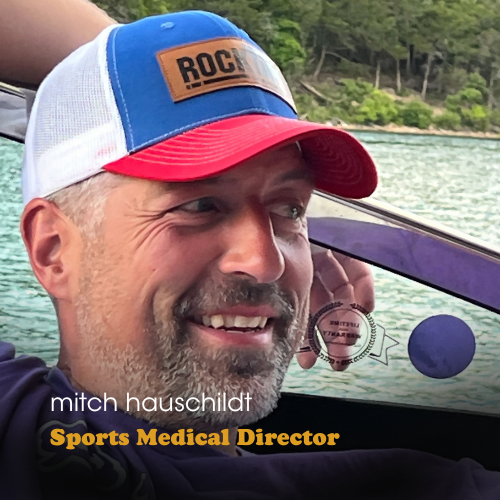
In this episode of The Fringe, Mitch Hauschildt (sports medicine specialist and clinical director at Fringe) sits down with Corey Tremble, Director of Medical Operations for the Miami Marlins and a 20-year veteran of professional baseball. Together they dig into how sports medicine has evolved, what a truly collaborative athlete care team looks like, and why workload management is at the heart of keeping athletes healthy and on the field.
Corey and Mitch share their philosophy of "loading tissue" and building resilience rather than simply reacting to injuries. Red light therapy gets a central role in the conversation — not as a magic bullet, but as what Mitch calls a "condiment": something that layers on top of manual work, dry needling, and blood flow restriction to speed recovery and reduce tissue damage. They walk through specific case studies including how RLT has transformed bruise recovery, post-op UCL rehab, and the shift away from ice as a default intervention.
If you work in sports medicine, coach athletes, or are simply curious about how elite performance teams think about recovery, this conversation offers a candid look at real-world application — and why the most effective approaches are always about stacking the deck, not following a single protocol.
Listen on the go — The Fringe podcast is available on Spotify and YouTube. Subscribe so you never miss an episode.
Transcript
Mitch Hauschildt: All right. Welcome to the fringe. Excited to be here. So, my name is Mitch Hauschildt. Those of you guys I haven't met — this is actually my first time hosting our podcast. I am the sports medicine and clinical director at Fringe. I've got a long history of working in the sports medicine fields, as an athletic trainer and a strength coach. My role at Fringe is to really support our clinical staff and make sure they have all the education they need, all the product they need, and everything that needs to be put in place for them to be successful. But I am also still a practicing clinician. I'm the rehab and injury prevention coordinator at Missouri State University. My days are spent doing injury prevention and rehab with Division 1 athletes, which keeps me in the weeds and busy. I get to use our products and relay a lot of that information back to our clinical friends. I'm super stoked to have Corey Tremble with us. Corey is a longtime friend of mine, has a long history of working in professional baseball. I'm gonna kick it to him and let him do his own intro.
Corey S. Tremble: Yeah, no, great. Thanks, Mitch. Love being on the fringe here today. So a little bit about me — my name is Corey Tremble. I've worked in professional baseball the last 20 years. Currently, I'm the Director of Medical Operations for the Miami Marlins. In that role, I oversee the entire medical umbrella from the Major League team all the way down to our Academy in the Dominican Republic. Anywhere between 20 plus direct reports with a bunch of physicians and the whole paradigm of the sports medicine contingent. I'm in my second year here. Prior to that I spent one year with the Texas Rangers and then before that was 17 years with the Detroit Tigers. Most of my experience is with baseball which I think really plays into what Fringe does and the products they put out because we are constantly chasing workload and trying to find ways to stack the deck any way we can. In my current role I'm leveraging the doctorate I achieved at Florida International University in academic and entrepreneurial leadership — really utilizing that in creating process and feedback loops and mentoring programming and really starting to zoom out and look at how can we create a department built on trust, integrity, and a player-centered approach. That's what we try to do with the Marlins. And that's where products like red light therapy have really become a huge piece to our day to day.
Mitch Hauschildt: You and I, when we first met, you were the rehab coordinator with the Tigers. You happened to stumble into a tape class I was teaching. We started talking. You guys had some of our Missouri State guys that were in your system. That's really what our background is and how we met.
Mitch Hauschildt: I love what you were just saying and I think a lot of our clinical friends that are listening can relate. You've had this natural evolution of patient care now moving into a leadership role. Maybe expand on that just a little bit of how that has worked for you.
Corey S. Tremble: Sure, and I think everybody in their career has these lulls where they run into kind of a wall and go like, you know, is this what I really want to continue doing? Instead of pivoting or trying something different, I just kind of leaned into how to make the zoomed in program or the athlete better. I was taking a ton of courses, reading a bunch, but it really wasn't anything next level or bigger picture. I just started having higher level conversations with really intelligent people in a lot of leadership spaces. And it just seemed that that was going to be an avenue that would fulfill that hunger I had, but also allow a bigger picture mentality that could affect growth throughout an entire department. I think in a lot of our sports medicine settings, you just go from an assistant athletic trainer to a head athletic trainer to a director of athletic training — and it has nothing to do with more than time served. And I've seen that fail because it was just a higher paycheck of the same messaging. If we were going to do something bigger and better, we were going to have to reimagine and look at it a different way. So my day to day is filled with how can I mentor my younger clinicians to find out what makes them tick and put them in the position to get to what they want. And it's also — if everybody's thinking the same, nobody's thinking. That's where different modalities and different trains of thought can really come into play. We need a forum where everybody can talk about what they've seen and really bring that back to the forefront of what we're trying to do, which is put the player in the center of all of our decisions.
Mitch Hauschildt: I love that. Especially in pro baseball, you'd have guys working rookie ball for $18,000 a year on a nine month contract, slowly working up through the levels. Now it's really looking at the bigger picture. You not only have athletic training, but strength coaches, physicians, dietitians — this whole team approach. And then I'm guessing you've got some sports scientists, because you mentioned workload.
Corey S. Tremble: Yeah, and to see it evolve over the last 20 years is just bananas really. Right now we're holding our major league performance meeting before every game. It has six athletic trainers, two physical therapists, two dietitians, three strength conditioning coaches, our GM, and our pitching coach. Those days of just the head athletic trainer writing down on a piece of paper what this guy is going to do today — those days are done. We have one of the more robust staffs. We travel with five athletic trainers, one physical therapist, three strength coaches, and two dieticians. That's just the major league team with a roster of 26. And then we have our facility in Jupiter with four physical therapists, two athletic trainers, four strength coaches, and three dietitians for when players are on rehab.
Mitch Hauschildt: So what does that collaborative look like now? Because sports medicine was always king. You had the biggest voice, the most implication to the roster.
Corey S. Tremble: For a long time, athletic trainers knew we had the biggest piece to the pie and the strongest voice. And I think what ended up happening was we're starting to phase out those clinicians that are like my way or the highway. Now it's a much more collaborative, much more inclusive approach — we make sure that we touch every single department on every single player in our lineup. Because if we're fueling them better, if we're helping them recover better, if we're doing strategies in the strength conditioning side of things to not just maintain their strength but gain strength during the season — that creates such a better net for the player to have success. One of the biggest myths in all of baseball is that you just want to maintain during the season. So you're going to tell me that we're going to take the next six months of a 12 month year and just maintain our strength? And then you're going to take a month off at the end of the season? In a 12 month calendar year, you're going to try to get stronger for less than 5 months? We've had to change that mentality. Sports medicine is really the bystander in a lot of it. It's all these other spaces that are allowing us to have the good results on the back end on paper.
Mitch Hauschildt: Right. We've evolved as athletic trainers really to primary care physicians in a sense. We're the main contact point, but at the end of the day we're referring to PTs, sports psychologists, registered dieticians, strength coaches, and really tying those pieces together. And one of the big evolutions we've had in the last few years is we're now involved in conversations before we offer scholarships, which for the bulk of my career we never did. That's been good — now we at least know what we're getting ourselves into.
Corey S. Tremble: At the minor league level, we're still a one man band for the most part in a lot of spots. And that's where how can I leverage different modalities? How do I do some manual therapy with this player, and also get this player going? We have to be intentional of what we're buying, why we're buying it, and how it's benefiting our players day to day.
Mitch Hauschildt: So if you were to describe your practice philosophy, what does that look like?
Corey S. Tremble: Sure, and I think it's shifted over the years. When I got into baseball early on, I was so manual therapy minded — we were going to just make guys' tissue feel better. And it was like, well, why are you coming in every three or four days consistently? I guess I'm not doing a very good job of making you feel better. So then it shifted to more movement-based. The body just wants to move. Muscles don't know anything besides contracting and not contracting. They just know they're using their hamstrings — the hamstring has to contract. So now the philosophy with the Marlins is we are going to load tissue. We want to make sure that if we're going to get the most out of our athletes, we need to make sure they can accept that load, they're robust, they have the capacity to increase their volume and accept the intensity that we're asking them to do. The biggest shift for me has been getting away from being scared that if we load the tissue too much, that's gonna hurt them — versus understanding that actually if you load the tissue more often, more effectively, they're going to be more robust and actually a better athlete.
Mitch Hauschildt: I love that. So we have to load tissue, but then there's this word that keeps coming up — workload. Especially in pro baseball. You go back 50 years and guys were throwing 120, 150 pitches on an outing and coming back three or four days later. Now everything is about how do we manage workloads. How do you balance loading tissue with managing workload?
Corey S. Tremble: I think you have to be really strategic about it and look at it from a slightly different lens. Workload has this negative connotation — like we're going to stop players from playing. Reimagine it: we're going to track workload to give you the ability to do more. We're going to take away some of this fluff that might just be adding to chronic fatigue and we're going to be really intentional with the things that are going to give you the biggest bang for your buck. Instead of the two hour lift, we're going to do a 15 minute lift. Let's figure out how much time do you really need to prep the tissue, how much time do you really need to put the tissue under tension, and let's get minimum effective dose across the board. For instance, our relief pitchers don't throw before the game in the minor leagues. Historically, guys would go throw at 3 or 4 o'clock and then not throw again until 8:30 or 9 at night. Why would you let them throw high intensity at 3 o'clock and then not throw again until game time? It's like sprinting at 3 in the afternoon for your 8 o'clock race. So now if a guy doesn't throw in the game and wants to throw, they play catch after the game. We're putting all of our eggs in the basket of being the best version of ourselves when we're asked to do that in competitive game situations.
Mitch Hauschildt: What I'm hearing is intentionality. Get rid of the junk. Why are we playing catch just to play catch? And I think the workload problem in baseball isn't in game — it's all around the game. A relief pitcher going out there and throwing 16 pitches max effort — it's tough to say that's the workload that's hurting our players. What are the tools your guys are typically using?
Corey S. Tremble: Sure, and I think it's definitely shifted away from pain modulation as our focus. When I got into athletic training, it was stems and ice and how can we just take pain away and stop inflammation from happening. Versus now we're much more into creating inflammation. And there's a difference between throwing the kitchen sink at a player versus stacking the deck. You should know what is creating the change or improvement that you want. It's an easy one to say that red light therapy is an easy add-on to what the athlete's doing — it's an easy piece to add to their treatment process when they're not doing any treatment. If we're being very invasive on a player through needles, through shockwave, through anything really invasive that can cause soreness and kick-up inflammation, and we want to give that player a really good recovery day the next day, there are so many avenues to use red light therapy. It's not a patient-clinician interface that has to happen for it to happen. What can we do to allow athletes to recover well when we as clinicians aren't around them? And this is where I'd always challenge anybody that says a player just needs a treatment day. We're doing treatment to put the tissue in a better spot to go load the tissue again. So it's dry needles, the blood flow restriction machines, the pneumatic devices. And honestly — and I hate saying this because it's what we do for a living — the most inexpensive best way to recover is eat better and sleep better. It's also a big part of our process. Educating on food choices, how much sleep they're getting. It's okay to get 10 hours of sleep as an athlete. Do it. We want that.
Mitch Hauschildt: Yeah. I mean, I love that. And there's a difference between throwing the kitchen sink at somebody and stacking the deck. In our younger years it's like, well, I don't know what to do, so we're just going to throw everything we can think of. Then as you get older and more experienced, you start to look at, okay, I can use this tool for this mechanism, this tool for that mechanism, and I can stack them together. One of my favorite stacks we've discovered with our athletes for bruising — take a quad contusion, a guy takes a foul ball off their shin. We stumbled across this last fall: if we do dry needling with small 15mm needles throughout the area to stimulate lymphatic flow, then do red light over top of that, then put BFR on that extremity at a recovery setting — 4 minutes with 80% occlusion, a minute and a half reperfusion, repeat for 30 minutes — those guys come back the next day looking like nothing ever happened. We're getting lymphatic flow, we're regulating inflammation, and we've got blood flow being flushed into the area. That's stacking, not just throwing stuff.
Corey S. Tremble: Right, and your why is really strong. Athletes are way more well-read now. They are way more intelligent than they probably ever have been. You can't car-sales them into a treatment plan or a rehab program. They really want to know the why and we should be able to tell them it.
Mitch Hauschildt: Talk to me about inflammation because you mentioned you're actually introducing more of it now than you used to.
Corey S. Tremble: In baseball, you have so much that's acute on chronic or chronic — it's constantly trying to play catch up. You never have three days where it's like, okay, we're just going to get this under control. It's just constantly bringing the gauge down. What really changed our mindset is understanding that inflammation wasn't the villain. Our athletes aren't coming in unable to move their elbow because of inflammation. They're sore in their flexor pronator group because of chronic workload. So it's how can we make them feel better, and how can we jumpstart the process. A lot of what we see in baseball — these acute on chronic or chronic tendinopathies — is actually a lack of blood flow, not true inflammation. By kicking it up, we're actually helping the tissue. Stacking the deck: if we use dry needles or BFR to increase blood flow to an area that's going to create some micro damage and kickstart the inflammatory process, what can we do to make sure that inflammation is doing good by us? That's where red light therapy is so great. We know there's going to be traffic, but red light therapy comes in and it's like — I'm the traffic cop. I'll make sure everything goes right. How are we leveraging the healing process? How do we make sure we're not just kicking up inflammation, but making sure that's actually benefiting us and not hurting us?
Mitch Hauschildt: So I'm guessing there's not a lot of ice and NSAIDs in your training room anymore.
Corey S. Tremble: No, we've gotten away from that quite a bit. Ice is for our post-game drinks. That's about it. And where do I put red light therapy in my clinical flow? Exactly what you said — the things we used to heat and ice, replace that with red light therapy. You're going to get a similar pain-relieving effect but now you're getting healing properties, upregulating cellular metabolism, working at a cellular level.
Mitch Hauschildt: Is there anything specific your guys are using red light therapy for in the field?
Corey S. Tremble: We're using it a ton for our post-op UCL reconstructions — putting it right over the elbow. The surgery has evolved now. They don't just reconstruct the ulnar collateral ligament — now they're also putting in an internal brace, so there's more tissue and more to heal. We're also seeing more flexor strains on top of the ligament. We're seeing them out front now where it's almost like this eccentric pull off the medial epicondyle — big pronated and supinated pitches held for much longer, so it's this eccentric pull ripping the tendon along with the ligament. There's just so much more damage going on in the elbow than with the traditional Tommy John surgery. So we have pitchers that are two or three years out that will still red light their elbow the day after they pitch, and before they go out to pitch. We're also using it in place of ice — guy fouls a ball off his shin, we're putting that on it instead of a big bag of ice. And it travels really well. Baseball is 81 road games — if we can't travel with it, it's a really tough thing for us to buy. When you showed me what Fringe had, that also changed my mind — it's cost-effective, portable, can be used every single day for every single athlete at some spot in their treatment program.
Mitch Hauschildt: I have personal experience with this — we actually have a case report on the Fringe website of a post-op elbow UCL repair, which happened to be my 16-year-old son. He's a catcher. He evolved a UCL at the distal end when he was 16 — travel ball all spring, caught every game through the high school season, finished districts on a Thursday, and Saturday morning we're playing a travel ball tournament. I used red light with him after surgery, once a day every day, and his outcomes have been phenomenal. Is that the only reason? No, but it was a real game changer compared to ice. And one of the things I want to mention — we just launched our red light mats, a full-body solution. I actually think full-body red light therapy is where we're going to evolve to. There's such a systemic effect. We have so much inflammation in our bodies because of the amount of sugar we consume, the caffeine, the crap we're putting in our bodies, and the lack of sleep. Since I got my red light mat — it's just like a yoga mat with a lot of red light in it, cordless, rolls up — my body feels amazing. I'm 48, I've had six knee surgeries, I've got some miles on my body. I do think we're going to evolve to the point where that is where it's at.
Corey S. Tremble: And that's what you need in baseball — something portable. I can't remember the last time we turned on an ultrasound machine, the therapeutic kind. E-STEM has really kind of died except with dry needles. IFC and all that is just really not it anymore. But the thing that's great about red light is it's like a condiment to some of the other therapies that we're doing. It's not a standalone add-on — it's an add-on in conjunction with. It's not invasive. It's not to the point where we're hurting tissue or hitting on tissue more. A really deep massage, you know that might bring some soreness the next day. Red light isn't going to do that, but it's definitely going to help. That's where it's been the biggest bang for our buck — such a great add-on to what we're already doing.
Mitch Hauschildt: I love that idea of the condiment. You've got your hot dog and it's good — but it's a little bit better when you add some onions, some relish. I'm a ranch guy, so ranch can go on anything. Any final thoughts or pearls for our listeners?
Corey S. Tremble: Stay open-minded. I think all athletic trainers want to say that they're open-minded and constantly learning, and you hear all these buzzwords, but then they always gravitate back to what they know works. Get uncomfortable. Get really comfortable with being uncomfortable. Challenge how you think. Challenge what you believe. And especially for our young clinicians out there — don't be scared to speak up. Inexperience can be a real superpower because you don't have biases. You don't have things that you think work or don't work. Speak up to some old guy like me and say, no, no, why don't we look at this again? I want all of my staff to think independently and critically. Everybody in sports medicine uses the tagline of I'm a career learner — well okay, then be about it. Open up your mind. Be willing to change. And I would say red light is one of the microcosms of that bigger picture thinking. I was not a big fan. I didn't believe in it. And now, from changing the way I thought, I think better.
Mitch Hauschildt: Greatest moments of discomfort are also our greatest opportunities for growth. Red light therapy is all over social media because it looks really good — it looks awesome on Instagram. Us as clinicians, we naturally push back: great for Instagram doesn't mean it actually works. But in this case, you and I agree that we've seen some pretty amazing outcomes with it. It's been a really valuable tool. All right, well on that note, we're gonna sign off. Corey, thank you so much for the time. I always enjoy our conversations. Hopefully I can see you soon in person. And I do have some Marlins gear still in my closet that I pull out every now and then.
Corey S. Tremble: We'll have to get you updated. Wonderful. Thank you.