

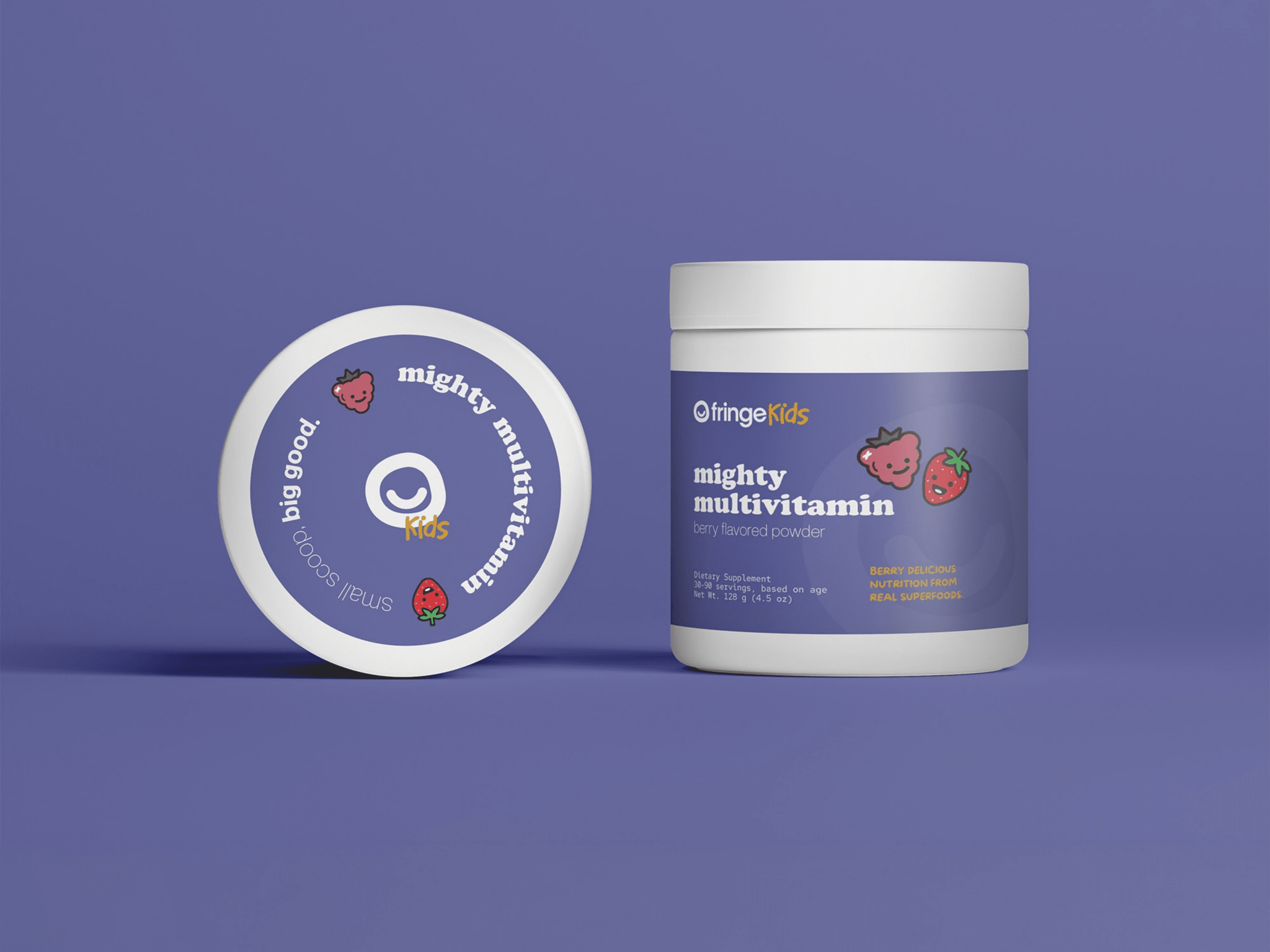
We’re excited to introduce the Fringe Kids Mighty Multivitamin, a food-based vitamin and mineral supplement designed to support growing bodies.
This formula was created to fill common nutritional gaps in children’s diets using primarily food derived ingredients rather than synthetic isolates. It provides foundational vitamins and minerals that support energy, learning, immune function, and overall development, without added sugar, artificial or “natural” flavors, dyes, or unnecessary additives.
At Fringe, we believe children deserve supplements that are as thoughtful and intentional as the food we try to put on their plates. The Kids Mighty Multivitamin was designed with that philosophy in mind.

Nutrient Depletion and Nutrient Gaps in Modern Childhood
When we look at the context for children’s nutrition today, it helps to separate two related but distinct issues. One is the nutrient content of what children eat and drink. The other is whether what they consume provides enough of the vitamins and minerals their bodies need for growth, learning, immunity, and everyday function.
Many aspects of our food supply have shifted over the past several decades in ways that can affect both vitamin and mineral content. Studies of nutrient density in fruits, vegetables, and staple crops have documented declines in both minerals and vitamins compared with historical baselines, reflecting changes in agricultural practices, plant breeding, soil quality, and global food systems. These analyses have found measurable drops in nutrients such as calcium, magnesium, iron, vitamin A, and vitamin C in a range of produce over time, suggesting that even when children eat foods that appear wholesome, the absolute nutrient content per serving may be lower than it once was. Magnesium has been especially affected, with losses of up to 80-90% in some foods over the last century.
In addition to agricultural influences, naturally occurring minerals in water such as calcium, magnesium, sodium, chloride, and potassium have traditionally contributed to daily intake for many individuals. Depending on local water composition, these minerals can account for meaningful portions of recommended intake values, particularly for calcium and magnesium. However, modern filtration practices remove these minerals from water in the process of ridding them of contaminants, which can reduce overall nutrient intake. Collectively, these patterns in food and water help explain why certain micronutrients are consistently identified as shortfall nutrients in U.S. dietary surveys.
National data from the National Health and Nutrition Examination Survey (NHANES) show that many U.S. children do not meet recommended intakes for multiple vitamins and minerals when intake is assessed from foods and beverages alone. In toddlers and young children, large proportions fall below the Estimated Average Requirement (EAR) for vitamin D and vitamin E, while most do not reach Adequate Intake (AI) levels for potassium and choline. As children move into the school-age years, nutrient gaps widen, with continued inadequacy in vitamin D, vitamin E, calcium, choline, and potassium. By adolescence, NHANES data show widespread shortfalls across a broad range of nutrients, including vitamin D, vitamin E, calcium, magnesium, folate, iron, and potassium, with particularly high rates of inadequacy among adolescent females. These patterns occur even when overall calorie intake is sufficient, indicating that nutrient gaps reflect dietary quality and food patterns rather than simple undereating.
These gaps are not simply a “picky eater” issue. They reflect modern dietary patterns that can provide adequate calories while still falling short on micronutrients. One major factor is the high proportion of daily calories coming from ultra processed foods among U.S. youth. Ultra processed food intake increased among U.S. youths from 1999 to 2018, with recent CDC NHANES-based surveillance data reporting that youth ages 1 to 18 obtain about 62 percent of calories from ultra processed foods. When a large share of the diet is coming from foods designed for convenience, shelf stability, and hyper palatability, there is less room for consistent intake of nutrient dense staples like vegetables, legumes, seafood, and mineral rich whole foods.
The take-home point is that nutrient gaps in U.S. children are measurable, consistent, and widespread, affecting both vitamins and minerals. These gaps matter because many micronutrients support foundational biological processes, from energy metabolism to immune signaling to neurologic development. When intake falls short of recommended levels year after year, it contributes to what nutrition scientists describe as chronic insufficient intake, or “micronutrient gaps,” rather than acute clinical deficiency. Addressing these gaps requires thoughtful support for nutrients that are hard to obtain consistently from modern diets alone. This is the context in which a carefully designed children’s multivitamin can serve as a nutritional backstop for growing bodies.

Why These Nutrients Matter During Childhood
Identifying nutrient gaps is only part of the picture. It is also important to understand why adequate intake matters during childhood, when growth and development place higher and more dynamic demands on the body. Vitamins and minerals support fundamental biological processes, and when intake consistently falls below age-appropriate needs, those processes can be affected even in the absence of overt deficiency disease.
1) Growth and physical development
Normal growth during childhood depends on the coordinated activity of multiple micronutrients that support cell division, tissue development, and skeletal maturation. Zinc plays a role in growth and bone formation, calcium and vitamin D are central to bone mineralization and skeletal integrity, magnesium supports bone structure and energy metabolism, and iron contributes to oxygen delivery and physical capacity during growth. Research has shown that inadequate intake or status of these nutrients can be associated with impaired growth patterns, reduced bone mineral density, or suboptimal physical development, particularly during periods of rapid growth. While severe deficiency states are uncommon in high-income countries, habitual intakes that fall below recommended levels may still limit optimal support for these foundational processes over time.
2) Brain development, learning, and cognition
Brain development during childhood relies on a steady supply of micronutrients that support neuronal growth, myelination, neurotransmitter synthesis, and energy metabolism in the nervous system. Iron is required for oxygen delivery and normal neurodevelopment, and inadequate iron status in childhood has been associated with alterations in cognitive development and attention. Iodine is essential for thyroid hormone production, which plays a central role in brain development and cognitive function, particularly during early life. Choline contributes to cell membrane structure and neurotransmitter synthesis and is involved in pathways related to memory and learning, yet intake is consistently low in children. Several B vitamins, including folate, vitamin B6, and vitamin B12, support one-carbon metabolism and neurotransmitter production, while magnesium participates in neuronal signaling and energy metabolism. When habitual intake of these nutrients falls below recommended levels, it may limit optimal support for the developing brain, especially during periods of rapid learning and cognitive growth.
3) Immune function and energy metabolism
The immune system and the body’s ability to produce and regulate energy are closely tied to micronutrient status during childhood. Vitamin A supports the integrity of epithelial barriers and immune cell differentiation, while vitamin D plays a regulatory role in both innate and adaptive immune responses. Vitamin C and zinc contribute to immune cell function and antioxidant defense, and inadequate intakes have been associated with altered immune responsiveness. At the same time, nutrients such as magnesium, iron, and B vitamins are involved in mitochondrial function and enzymatic reactions that govern energy production and cellular metabolism. When intake of these nutrients is consistently low, children may have less metabolic flexibility to meet the demands of growth, physical activity, and immune challenges, even if overt illness or deficiency is not present.
Taken together, this research highlights that vitamins and minerals support a wide range of foundational processes during childhood, from physical growth to brain development to immune and energy regulation. When intake consistently falls short of age-appropriate needs, these systems may be supported less efficiently over time, even in the absence of overt deficiency. This is the context in which maintaining adequate, consistent micronutrient intake becomes relevant to everyday childhood health.

Why We Consider a Multivitamin “Essential” for Kids (Even for Healthy Eaters)
We consider a children’s multivitamin essential because meeting nutritional needs consistently over time is challenging, even in families that prioritize healthy food. As we’ve just seen, nutrition needs are often unmet due to nutrient gaps, water and mineral depletion of vitamins and minerals, and high consumption of ultra processed food. In addition, childhood is a period of rapid growth and development, and the demand for vitamins and minerals shifts alongside physical growth, brain development, immune maturation, and learning. At the same time, food intake is rarely steady, varying with changes in appetite, preferences, and habits.
Even with a well-planned diet, children do not eat the same foods in the same amounts every day, and nutritional adequacy is determined by patterns over weeks and months rather than by individual meals. Some nutrients need to be consumed regularly to maintain adequate levels, and repeated shortfalls, even small ones, can accumulate during periods of growth. This reality is not a reflection of poor parenting or poor dietary choices, but a natural consequence of childhood and the modern food environment.
We believe that a daily kid’s multivitamin with minerals is “essential” because it provides a steady nutritional baseline when intake is uneven, inadequate, or unpredictable. While this support can be provided by synthetically sourced nutrients, food-based vitamins and minerals are delivered in amounts and combinations that more closely resemble how nutrients occur in the diet, which allows them to support physiology in a way that is gentler and more consistent with nature. In this context, a food-based multivitamin is better suited to act as an everyday nutritional backstop, working alongside real food rather than attempting to replace it or override normal dietary patterns.

Fringe Kids Mighty Multivitamin: What’s In It?
When we formulate supplements for children, we start by asking a simple question: what does the body actually need on a daily basis, and how can we provide that support in the most appropriate way? The Kids Mighty Multivitamin was built using a “nature first” philosophy with that question in mind, using a combination of whole-food nutrients, targeted additions, and carefully chosen supporting ingredients to create a formula that is both effective and gentle.
1. The Foundation: A Whole-Food Nutrient Blend
At the core of the Kids Mighty Multivitamin is a 21-nutrient, organically grown fruit and vegetable blend, which provides a broad spectrum of vitamins, minerals, and phytonutrients in a form that closely resembles how nutrients occur in food. This blend includes broccoli, spinach, kale, pumpkin, sweet potato, sunflower seed, cranberry, chlorella, maitake mushroom, and shiitake mushroom.
Because this multivitamin is built on a food-based foundation, some of the vitamin forms may look different from what people are used to seeing in standalone supplements. The vitamin D present in the blend is vitamin D2, and the vitamin K is vitamin K1, which reflect the forms naturally found in plant foods. Vitamin D3 and vitamin K2 can also be derived from natural, vegan sources and are often used in targeted supplements for specific goals (such as our Fringe Vitamin DK supplement). In this formula, however, the intent is different. As an everyday, food-based multivitamin, the goal is to provide gentle, consistent nutritional support using nutrient forms that align with how vitamins are typically consumed in the diet, while still supporting normal absorption and biological function.
By building our multivitamin around real foods rather than isolated synthetic vitamins, we aim to provide nutritional support that works alongside the body’s natural processes, rather than overwhelming them with high doses of single compounds.
2. What We Added, and Why
While a food-based foundation can provide a broad range of vitamins and minerals, it also reflects the realities of the modern food system. Declines in soil mineral content, loss of naturally occurring minerals from filtered water, and inconsistent intake of nutrient-dense foods mean that some nutrients are simply harder for children to obtain in adequate amounts, even with a diet built around whole foods. For that reason, relying on a fruit and vegetable blend alone is not always sufficient to meet foundational needs. Based on intake data and these practical constraints, we made the intentional decision to add three nutrients that consistently emerge as shortfall nutrients in children.
-
Magnesium was added because it plays a central role in energy metabolism, muscle and nerve function, and overall cellular health, and because both dietary intake and environmental availability have declined over time.
-
Calcium, sourced from calcified algae, was added to support bone development and growth during childhood, using a naturally derived form that fits within a food-based framework.
-
Choline is the only synthetic ingredient in the formula, and its inclusion was deliberate. Choline is essential for brain development, cell membrane structure, and neurotransmitter synthesis, yet intake is consistently low in children. Because choline is not present in meaningful amounts in most plant foods or food-based blends, we chose to include it as a standalone nutrient to ensure adequate support during key developmental years.
3. The Supportive Players
Beyond the primary nutrients, the Kids Mighty Multivitamin includes a small number of supportive ingredients that were chosen with equal care. Chicory root inulin provides a gentle source of prebiotic fiber to support gut health. Organic freeze-dried raspberry and strawberry fruit powders contribute natural flavor and color without added sugar or artificial ingredients. Organic rice hulls serve a functional role in the powder without introducing unnecessary additives.
For sweetness, we use thaumatin, a protein-derived sweetener sourced from the katempfe fruit. Thaumatin is intensely sweet, which allows us to use it in extremely small amounts, contributing virtually no calories and having no impact on blood sugar. Unlike many other sweeteners used in children’s supplements, thaumatin does not rely on sugar alcohols, stevia, or artificial sweeteners, making it a cleaner and better-tolerated option. Malic acid, which occurs naturally in fruits, is included to support flavor and palatability while fitting seamlessly into a food-based formulation. We’ve taste tested our Mighty Multivitamin with kids and they’ve loved it!
Every ingredient in the Kids Mighty Multivitamin serves a purpose. There are no dyes, added sugars, “natural” or artificial flavors, or unnecessary fillers. The goal is not to make a supplement that looks or tastes like candy, but one that supports children’s health thoughtfully and responsibly, using ingredients that align with how their bodies are meant to be nourished.

How to Use It
The Kids Mighty Multivitamin is designed to provide meaningful nutritional support without overwhelming the system or attempting to replace food. Across age groups, the recommended servings deliver supportive amounts of most vitamins and minerals, generally falling in at 30-70% of daily requirements. This is intentional. The goal is to leave room for nutrients to come from the diet while providing a steady baseline that helps cover common gaps when intake is uneven or unpredictable. At times when nutritional intake is clearly inadequate, the recommended daily dose can be increased by 1/3, 1/2, or – on rare occasions – even a full scoop.
For many nutrients, daily intakes in the range of moderate support rather than full replacement are both appropriate and desirable, particularly when a multivitamin is used long term. Calcium is a good example. The amount included in Kids Mighty is not intended to meet daily calcium needs on its own, but rather to mirror the type of calcium intake that typically accompanies meals. Most children obtain calcium primarily from food, and this formula is designed to complement that pattern rather than override it.
Vitamin D deserves special mention. While Kids Mighty provides a food-based source of vitamin D, many children will still require additional vitamin D supplementation depending on factors such as sun exposure, latitude, season, skin coverage, and time spent outdoors. When vitamin D is supplemented separately, vitamin K should also be included to support proper calcium handling and bone health. This is why we offer a dedicated vitamin D and K supplement for families who need targeted support beyond what a daily multivitamin can reasonably provide.
To use, simply mix the recommended serving into water, a beverage, or food of choice and stir well.
- Ages 2 to 3: ⅓ scoop daily
- Ages 4 to 8: ½ scoop daily
- Ages 9 and up: 1 scoop daily
Kids Mighty is not intended for children under 2 years of age.
As with all Fringe supplements, this product is meant to work alongside real food, not replace it. Think of it as a quiet, consistent layer of support that fits into daily life and adapts to the realities of growing bodies, changing appetites, and modern nutrition.
Kids Mighty Multivitamin & Our Small Scoops Mission
The Kids Mighty Multivitamin was created as a reflection of our Small Scoops Mission. We believe that supporting children’s health means being thoughtful and restrained, not aggressive or excessive. Supplements should work alongside food, respect the body’s natural processes, and provide meaningful support without unnecessary ingredients or high doses.
Every aspect of our Kids Mighty Multivitamin was designed with this philosophy in mind. A food-based foundation, targeted additions where modern diets often fall short, and carefully chosen supporting ingredients, all combined in amounts that are intended to complement, not replace, real food. Just as important are the ingredients we chose to leave out, including added sugars, artificial and “natural” flavors, dyes, and unnecessary fillers.
As parents, we take seriously the responsibility of formulating for children. The Small Scoops Mission is about stewardship, transparency, and long-term thinking, and Kids Mighty is our way of putting that into practice in a form that fits naturally into daily life.
Scoop, heal, repeat.


